


Files
Download Full Text (269 KB)
Description
Background
Extubation of preterm and term infants in a neonatal intensive care setting has always proven to be a challenge often resulting in failure. One of the challenges to a successful extubation in this vulnerable patient population is maintaining proper lung inflation at the time of extubation. We often rely on the use of the mean airway pressure (MAP) as an indicator to help predict patient readiness to extubate these patients.
Methods
23 patients ranging from 24 weeks to 41 weeks corrected gestational age were extubated from either conventional mechanical ventilation (CMV) or high frequency ventilation (HFV) using their mean airway pressure (MAP) as a guide. These patients were extubated at the discretion of their provider to either bubble CPAP (BCPAP) or noninvasive positive pressure ventilation (NPPV). A Ram cannula appropriate for patient size was used with both modalities. Successful extubation was defined as remaining extubated for a period of greater than 72 hours. Criteria for extubation failure was defined as frequent periods of apnea or periodic breathing with a sustained increase in FiO2 requirement greater than 50%.
Results
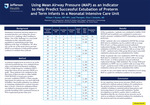
- Of the 23 patients, 7 patients were extubated to bubble CPAP (BCPAP)and 16 patients were extubated to noninvasive positive pressure ventilation (NPPV) depending on physician preference.
- Of the 7 patients who were extubated to BCPAP the average MAP prior to extubation was 8.5 cmH2O with an average FiO2 of 23%. 5 of these patients received surfactant replacement therapy while intubated. The average MAP post extubation on BCPAP was 6.3 cmH2O with an average FiO2 of 28%. 1 patient (14%) of this group did not meet successful extubation criteria and was reintubated (See Table).
- Of the 16 patients who were extubated to NPPV the average MAP prior to extubation was 8.2 cmH2O with an average FiO2 of 29%. 12 of these patients received surfactant replacement therapy while intubated. The average MAP post extubationon NPPV was 10.9 cmH2O with an average FiO2 of 35%. 4 patients (25%) of this group did not meet successful extubation criteria and were reintubated (See table).
- Overall, we saw a low failure rate for extubationof 22% using MAP as a guide for extubationreadiness in our patients.
Conclusion
In our experience mean airway pressure (MAP) can be a useful tool to indicate patient readiness for extubation in the preterm and term neonatal population. It can be valuable in helping to maintain patient lung patency and increasing chances of successful extubation. Further investigation is needed to analyze data to confirm our hypothesis that the use of mean airway pressure can be used as an indicator of patient readiness for extubation in the preterm and term neonatal population.
Publication Date
12-6-2025
Keywords
airway pressure, extubation, infants, neonatal intensive care unit
Disciplines
Medicine and Health Sciences | Pediatrics | Pulmonology
Recommended Citation
Bucher, RRT-NPS, William F. and DeSantis, MD, Eliza C., "Using Mean Airway Pressure (MAP) as an Indicator to Help Predict Successful Extubationof Preterm and Term Infants in a Neonatal Intensive Care Unit" (2025). Division of Pulmonary, Allergy, and Critical Care Medicine Posters. 8.
https://jdc.jefferson.edu/pulmcritcareposters/8



Comments
Presented at the American Association for Respiratory Care (AARC) Congress 2025.