


Files
Download Full Text (895 KB)
Description
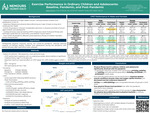
Background: The COVID-19 pandemic might have created considerable negative impacts on the physical fitness of ordinary adolescents, which may pose a major threat to long-term cardiovascular health.
Methods: Healthy adolescents (ages 11 to 18) who underwent cardiopulmonary exercise testing (CPET) were grouped into baseline (~ 3/2020), pandemic (4/2020 ~12/2022), and post-pandemic (1/2023~ 5/2024) periods. Data are shown as mean ± standard deviation.
Results: Peak oxygen consumption (VO2/kg) and peak work rate (WR/kg) were significantly reduced during pandemic in both sexes and did not improve during post-pandemic in males (Table 1). The decline of peak oxygen pulse (OP/kg) during pandemic persisted through post-pandemic in both sexes. Submaximal slope parameters including oxygen uptake efficiency slope/kg, Δ[VO2/kg]/Δheart rate, and work efficiency (ΔVO2/ΔWR) were significantly diminished from baseline with no difference between pandemic and post-pandemic periods in both sexes. Ventilatory anaerobic threshold (VAT)/kg remained unaltered over all periods in both sexes. Peak respiratory exchange ratio and ventilatory efficiency (ΔVE/ΔVCO2) revealed some sex differences.
Conclusions: Exercise performance was significantly reduced during pandemic and did not improve during post-pandemic when the pandemic restriction was released. These CPET trends, including some sex differences, may characterize
Publication Date
2-2-2026
Keywords
cardiopulmonary exercise testing (CPET), cardiovascular health, exercise physiology, physical deconditioning, sedentary lifestyle
Disciplines
Cardiology | Medicine and Health Sciences | Pulmonology
Recommended Citation
Skiena, Abby; D'Aloisio, MS, Gina; and Tsuda, MD, Takeshi, "Exercise Performance in Ordinary Children and Adolescents: Baseline, Pandemic, and Post-Pandemic" (2026). Alpha Omega Alpha Research Symposium Posters. 24.
https://jdc.jefferson.edu/aoa_research_symposium_posters/24



Comments
Presented at the 2026 AOA Research Symposium.