


Files
Download Full Text (1.4 MB)
Description
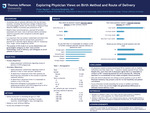
Purpose: In the United States, rates of cesarean deliveries (CD) have been increasing. Despite recommendations from the American College of Obstetrics and Gynecology to prevent increasing rates of CDs, planned CD has been associated with lower rates of perinatal deaths and better maternal outcomes when compared to planned vaginal delivery (VD). However, the data is limited, so it is important that we conduct randomized controlled trials (RCTs) comparing maternal and perinatal outcomes in planned CD vs planned vaginal delivery (VD) for nulliparous, term, single, vertex pregnancies. The purpose of study is to survey obstetricians and gynecologists (ob/gyns) on their views of birth methodology, route of delivery, and willingness to enroll patients in such a trial.
Methods: A web-based survey was sent to attending ob/gyns. The survey was open for eight weeks and hosted on the institution’s REDCap.
Results: Eighteen physicians participated, predominantly women (15, 83.3%) with 10-19 years of experience (8, 44.4%). Nearly all respondents (16, 88.9%) reported that patients often request planned VD, while requests for planned CD occur < 4 times per month (11, 61.1%) or between 4-8 times per month (3, 16.7%). Eleven (61.1%) agreed a trial evaluating planned CD is reasonable. Six (33.3%) expressed willingness to enroll all eligible patients; 3 (16.7%) would enroll some patients.
Conclusion: More than half of physicians agreed to conducting an RCT on planned VD versus planned CD. However, few expressed willingness to enroll patients in such a trial, suggesting that physician hesitancy may be a barrier to trial feasibility and recruitment.
Publication Date
2-2-2026
Keywords
planned cesarean delivery, cesarean delivery, planned vaginal delivery, vaginal delivery, birth methodology, delivery method, physician survey, physician opinion
Disciplines
Medicine and Health Sciences | Obstetrics and Gynecology
Recommended Citation
Nguyen, Vivian and Berghella, MD, Vincenzo, "Exploring Physician Views on Birth Method and Route of Delivery" (2026). Alpha Omega Alpha Research Symposium Posters. 22.
https://jdc.jefferson.edu/aoa_research_symposium_posters/22



Comments
Presented at the 2026 AOA Research Symposium.