Printing is not supported at the primary Gallery Thumbnail page. Please first navigate to a specific Image before printing.
-
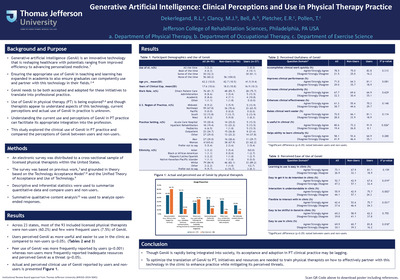
Generative Artificial Intelligence: Clinical Perceptions and Use in Physical Therapy Practice
Robert Dekerlegand, Malachy Clancy, Alison Bell, Erin Pletcher, and Travis Pollen
Background and Purpose
- Generative artificial intelligence (GenAI) is an innovative technology that is reshaping healthcare with potentials ranging from improved efficiency to advancing personalized medicine.1
- Ensuring the appropriate use of GenAI in teaching and learning has expanded in academia to also ensure graduates can competently use and partner with this technology in their fields.2-4
- GenAI needs to be both accepted and adopted for these initiatives to translate into professional practice.
- Use of GenAI in physical therapy (PT) is being explored5,6and though therapists appear to understand aspects of this technology, current perceptions and actual use of GenAI in practice is unknown.
- Understanding the current use and perceptions of GenAI in PT practice can facilitate its appropriate integration into the profession.
- This study explored the clinical use of GenAI in PT practice and compared the perceptions of GenAI between users and non-users.
-

Impact of Educational Models on Student Confidence in Acute Care Physical Therapy: A Comparative Analysis
Robert Dekerlegand, PT, MPT, PhD, CCS
Background and Purpose
- Hybrid and blended education have evolved as innovative models to deliver physical therapy (PT) education.1
- PT faculty rapidly integrated these models into their pedagogy during the COVID pandemic in 2020 and many have retained these methods.1
- Assessment of these models most frequently use cognitive indicators of learning outcomes (e.g. National Physical Therapy Examination).2
- Noncognitive indicators (e.g. confidence and self-efficacy), should be considered when assessing new educational models in PT given their relationship with competency and career direction.3-5
- The impact of “distance models” on noncognitive learning indicators is of particular value to acute care where face-to-face interactions may be paramount to cultivating interest, confidence, and self-efficacy.
- This study compared changes in acute care self-efficacy (ACSE) in response to differing educational models in entry-level PT students.
-
Adoption and Awareness of Long-COVID Clinical Practice Guidelines Among Physical Therapists: A Nationwide Survey
Robert Dekerlegand, PT, MPT, PhD, CCS and Malachy Clancy, PhD, OTR/L, BCPR
Background and Purpose
- Approximately 15% of individuals infected with SARS-CoV-2 develop “Long-COVID” with persistent physical, cognitive, and/or mental symptoms potentially amendable to physical therapy.
- Variability exists in the rehabilitation approach for individuals receiving physical therapy for this novel condition.
- Clinical practice guidelines (CPGs) and other evidence-based resources exist to help standardized rehabilitation; however, it is unknown if physical therapists (PTs) are applying them in the management of individuals with Long-COVID.
- We surveyed PTs in the contiguous United States (U.S.) to explore their awareness and application of Long-COVID CPGs along with their general awareness of this condition.
-

The Efficacy of Inspiratory Muscle Training Post COVID: A Systematic Review
Robert Dekerlegand, Sydney Brannen, Olivia Bunch, Amrit Deo, Erin Dopke, and Kayleigh Moreland
Introduction
- Fatigue and dyspnea can persist post COVID infection and negatively impact both functional capacity and quality of life (QOL).1,2
- Residual pulmonary impairments and/or inspiratory muscle dysfunction associated with COVID infection contribute to these symptoms.2,3
- Ventilatory demands exceeding the capacity of the inspiratory muscles can exacerbate these symptoms accentuating activity limitations that restrict participation in life roles.
- As symptom-limited exercise and QOL are related to inspiratory muscle function post COVID,4,5 inspiratory muscle training (IMT) may improve rehabilitation outcomes.3
- The purpose of this systematic review was to determine the potential efficacy of IMT in individuals post-COVID.