


Files
Download
Download Full Text (1.2 MB)
Description
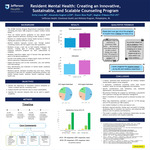
Background
- The ACGME Common Program Requirements emphasize resident well-being and expect GME programs to support resident mental health.1
- There are limited specific guidelines on how mental health support should be delivered, resulting in wide variability.1,3
- Research on resident-specific mental health services is limited, making best practices difficult to define.
- Medical students typically receive care through student counseling centers; but this support ends after graduation.3
- Residents occupy a dual role as both hospital employees and learners, creating gaps in existing support models, as employee assistance programs are often underutilized by residents.
- Residents experience higher rates of burnout than age-matched peers in the general population.4
- Suicide is the leading cause of resident death; nearly one-third of interns experience a depressive episode.2,5
- Stigma and barriers such as time constraints, cost, and waitlists limit help-seeking.4
- Early identification and treatment of mental health conditions improve outcomes.4
- Residency-specific demands—including long work hours, limited autonomy to take time off, mandatory educational activities, and limited backup—require solutions beyond traditional mental health care.
Publication Date
2-11-2026
Keywords
GME, resident well-being, resident counseling center, resident mental health
Disciplines
Medicine and Health Sciences | Psychiatry
Recommended Citation
Lisco, MD, Emily; Hughes, LCSW, Alexandra; Blue, PsyD, Shawn Thomas Jefferson University; and O’Meara, PhD, LPC, Meghan, "Resident Mental Health: Creating an Innovative, Sustainable, and Scalable Counseling Program" (2026). Department of Psychiatry and Human Behavior Posters. 8.
https://jdc.jefferson.edu/phbposters/8



Comments
Presented at the 2026 ACGME Annual Educational Conference: Meaning in Medicine.